
Loading...
⚡ 1kg Low MOQ · Factory Direct Glitter & Mica⚡ Source Factory Direct Wholesale · Custom Loose Glitter & Mica Pigments · 1kg Low Trial MOQ · 48h Free 50g Lab Samples
mlmcustom@mlmcosmetic.com⚡ 1kg Low MOQ · Factory Direct Glitter & Mica⚡ Source Factory Direct Wholesale · Custom Loose Glitter & Mica Pigments · 1kg Low Trial MOQ · 48h Free 50g Lab Samples
mlmcustom@mlmcosmetic.comLoading...
Technical B2B comparison of chameleon pigment powder vs holographic glitter for cosmetics. Particle specs, regulatory compliance, and formulation stability.

For cosmetic formulators, R&D directors, and color cosmetics procurement managers, selecting between multi-chrome optics and diffractive spectral glitters requires a deep understanding of physical substrate engineering, rheological suspension dynamics, and evolving global chemical regulations. When analyzing chameleon pigment powder vs holographic glitter for cosmetics, formulators are not simply choosing an aesthetic effect—they are selecting between thin-film interference physics and geometric diffraction optics, each presenting distinct formulation constraints, processing requirements, and compliance profiles.
At MLM Cosmetic, our Shenzhen research and manufacturing facility produces high-purity effect materials tailored to strict international standards. Whether you are formulating anhydrous lip balms, solvent-based nail lacquers, or high-viscosity body gels incorporating Cosmetic Grade Biodegradable Glitter, understanding the mechanical and chemical parameters of these optical additives is essential for product stability and long-term commercial success.
Formulation failures in color cosmetics frequently stem from three primary blind spots when integrating optical effect materials:
Suspension Settling and Stokes' Law Discrepancies: Standard pearlescent chameleon pigments generally range in particle size from 10 µm to 150 µm, whereas traditional micro-precision holographic glitter particles range from 0.05 mm to 3.0 mm (1/128" to 1/8"). According to Stokes' Law, terminal settling velocity scales directly with the square of the particle radius. Integrating macro-particle holographic glitter into low-yield-stress emulsions (e.g., fluid body oils or thin gel formulations) inevitably leads to rapid gravitational sedimentation and phase separation unless rheological modifiers like synthetic hectorites or cross-linked acrylates provide sufficient yield stress (> 1.5 Pa).
Solvent Bleeding and Substrate Degradation: Standard holographic glitters engineered on non-crosslinked Polyethylene Terephthalate (PET) carrier substrates risk plasticizer extraction and dye leaching when exposed to aggressive polar solvents found in nail lacquers (such as ethyl acetate, butyl acetate, and isopropyl alcohol). Leachables can dull the diffractive rainbow effect and cause color bleeding into the surrounding matrix. Conversely, chameleon pigments based on inorganic synthetic fluorphlogopite (synthetic mica) or silica substrates exhibit absolute solvent inertia across organic and aqueous phases.
Microplastic Regulation Blind Spots (EU REACH Annex XVII): Formulators targeting European markets face strict compliance requirements under EU Regulation 2023/2054 amending REACH Annex XVII regarding synthetic polymer microparticles (microplastics). Traditional PET-based holographic glitters smaller than 5 mm are subject to sales bans and phase-out timelines. Cosmetic manufacturers must transition to modified cellulose-based (regenerated plant cellulose) holographic glitters or mineral-based synthetic mica chameleon pigments to maintain market access.
Chameleon pigment powders achieve smooth, dramatic color-shifting optical transitions (e.g., optical travel from deep violet to gold, or green to magenta) via precise thin-film interference. Synthetic fluorphlogopite or spherical silica flakes are precision-coated with alternating nanometer-scale layers of high-refractive-index and low-refractive-index metal oxides, typically Titanium Dioxide ($TiO_2$), Silicon Dioxide ($SiO_2$), and Iron Oxides ($Fe_2O_3$).
Because the structural matrix is fully inorganic, chameleon pigment powders demonstrate complete chemical inertia, superior light fastness, and high shear resistance during high-speed dispersion (e.g., triple-roll milling or high-shear rotor-stator processing).
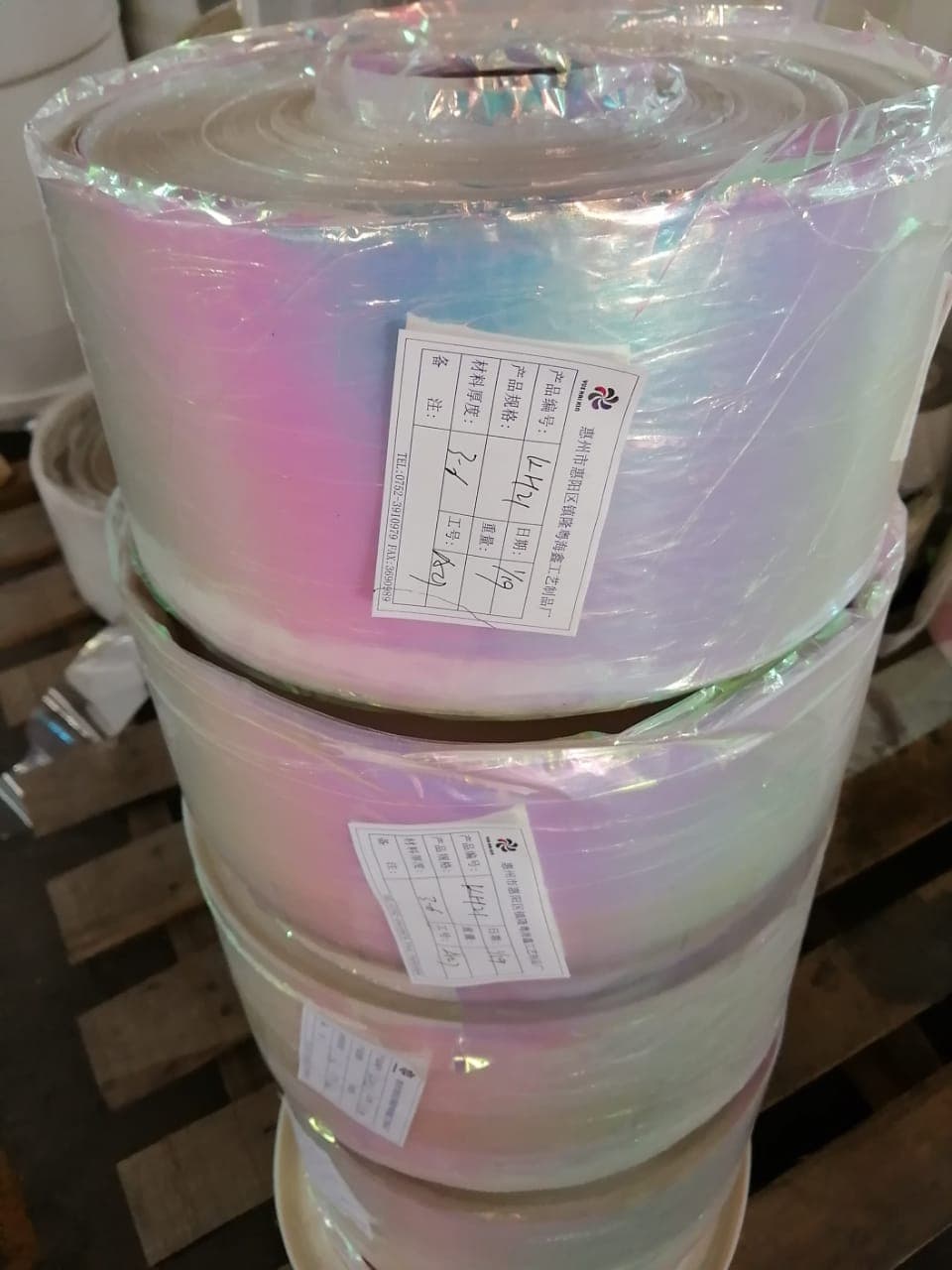
Holographic glitter achieves its rainbow-prismatic diffractive optical effect through precision mechanical engineering. A carrier film—either modified plant-derived regenerated cellulose or cosmetic-grade PET—is vacuum-metallized with a nanometer-thin aluminum coating and embossed with thousands of microscopic diffractive grooves per millimeter. The film is sealed with solvent-resistant, food-contact-approved polyurethane or acrylic topcoats before precision die-cutting into geometric shapes (hexagonal, square, or custom cuts).
When formulating with holographic glitter, high shear mixing must be avoided to prevent delamination of the protective topcoat and distortion of the diffractive micro-grooves.
| Parameter / Specification | Chameleon Pigment Powder | Holographic Glitter (Cosmetic Grade) |
|---|---|---|
| Core Substrate | Synthetic Mica / Silica / Borosilicate | Regenerated Plant Cellulose / PET |
| Primary Particle Size | 10–60 µm, 20–150 µm | 0.05 mm – 3.0 mm (1/128" – 1/8") |
| Optical Phenomenon | Angular Thin-Film Interference | Surface Micro-Diffraction |
| Thermal Stability Limit | Up to 800°C | 160°C – 200°C (Max 5 mins) |
| Solvent Resistance (EtOAc/BuOAc) | Complete Inertia (100% Resistant) | High (Requires Cross-Linked Polyurethane Topcoat) |
| Tactile Feel / Skin Feel | Ultra-smooth, non-perceptible | Slight tactile texture at >0.2 mm sizes |
| EU REACH Annex XVII Compliance | Fully Exempt (Inorganic Mineral) | Fully Compliant if Cellulose-based; Restricted if non-biodegradable PET |
| US FDA MoCRA Compliance | Fully Compliant (evaluated for intended decorative application/Lips per shade) | Compliant (Size/Area restrictions apply for PET in eye area) |
| Standard Packaging / Wholesale MOQ | 1 kg Sample / 25 kg Bulk Drum | 1 kg Sample / 25 kg Bulk Carton |
| Production Lead Time (Standard) | 5–7 Working Days | 7–10 Working Days |
Navigating global regulatory landscapes requires rigorous testing and documentation for every raw material lot:
Yes. Formulators frequently blend 3–5% chameleon pigment powder (10–60 µm) with 1–2% fine holographic glitter (0.05 mm or 0.1 mm) in anhydrous or gel bases. The chameleon pigment provides a continuous, multi-chrome background color travel, while the holographic glitter offers distinct, point-source spectral diffractive flares under direct lighting.
To ensure zero color bleeding, formulators must specify solvent-resistant cosmetic glitters protected with cross-linked polyurethane or acrylic topcoats rather than industrial craft glitters. Testing involves soaking the glitter sample in pure ethyl acetate/butyl acetate (50:50) at 40°C for 72 hours, followed by spectrophotometric evaluation of the supernatant liquid to confirm zero color extraction.
FDA compliance depends on the specific metal oxides used in the chameleon pigment layers. Titanium dioxide, iron oxides, and silica are fully approved for eye-area use. Shades containing Ferric Ferrocyanide or Chromium Oxide Greens are restricted in specific regions. MLM Cosmetic provides clear regulatory guidance and compliant batch-certified options for all target application zones.
When stored in original sealed fiber drums in a cool, dry environment (15°C to 25°C, relative humidity < 60%) away from direct sunlight, chameleon pigments have a shelf life of 5 years. Bio-based regenerated cellulose holographic glitters have a recommended shelf life of 24 to 36 months under dry conditions.
As a premier OEM/ODM cosmetic raw material manufacturer in Shenzhen, China, MLM Cosmetic offers advanced optical material manufacturing, precise color matching, custom particle size screening, and complete regulatory dossier packages for global cosmetic brands. Explore our full catalog of Bulk Cosmetic Mica Powder and high-performance effect pigments.
To request technical data packages, certificates of analysis, or custom sample kits, contact our technical sales team:
Disclaimer: Technical data and regulatory references provided herein (including EU Regulation 2023/2055, EU Regulation 1223/2009, and US FDA MoCRA) are based on current legislative texts and laboratory test parameters for raw materials manufactured by MLM Cosmetic. This documentation is intended solely to support independent brand formulators and Responsible Persons in compiling their Cosmetic Product Safety Reports (CPSR) and product filings. Final formulation compliance, toxicological risk assessment, and finished product registration remain the responsibility of the brand owner.
Looking for custom formulation or laboratory testing samples? Contact our MLM Cosmetic technical engineering team or request a free sample kit directly.
Target Formulation Material:
Chameleon Pigment Powder vs Holographic Glitter: B2B Cosmetic Guide
Includes 50g sealed lab pouch, lot-specific COA, Technical Data Sheet (TDS), and ISO 22716 regulatory package.
Whether formulating eyeshadow palettes, lip glosses, nail polishes, or compounding industrial epoxy resin, start with our 1kg low trial MOQ or complimentary 50g qualification sample with complete TDS and batch COA.